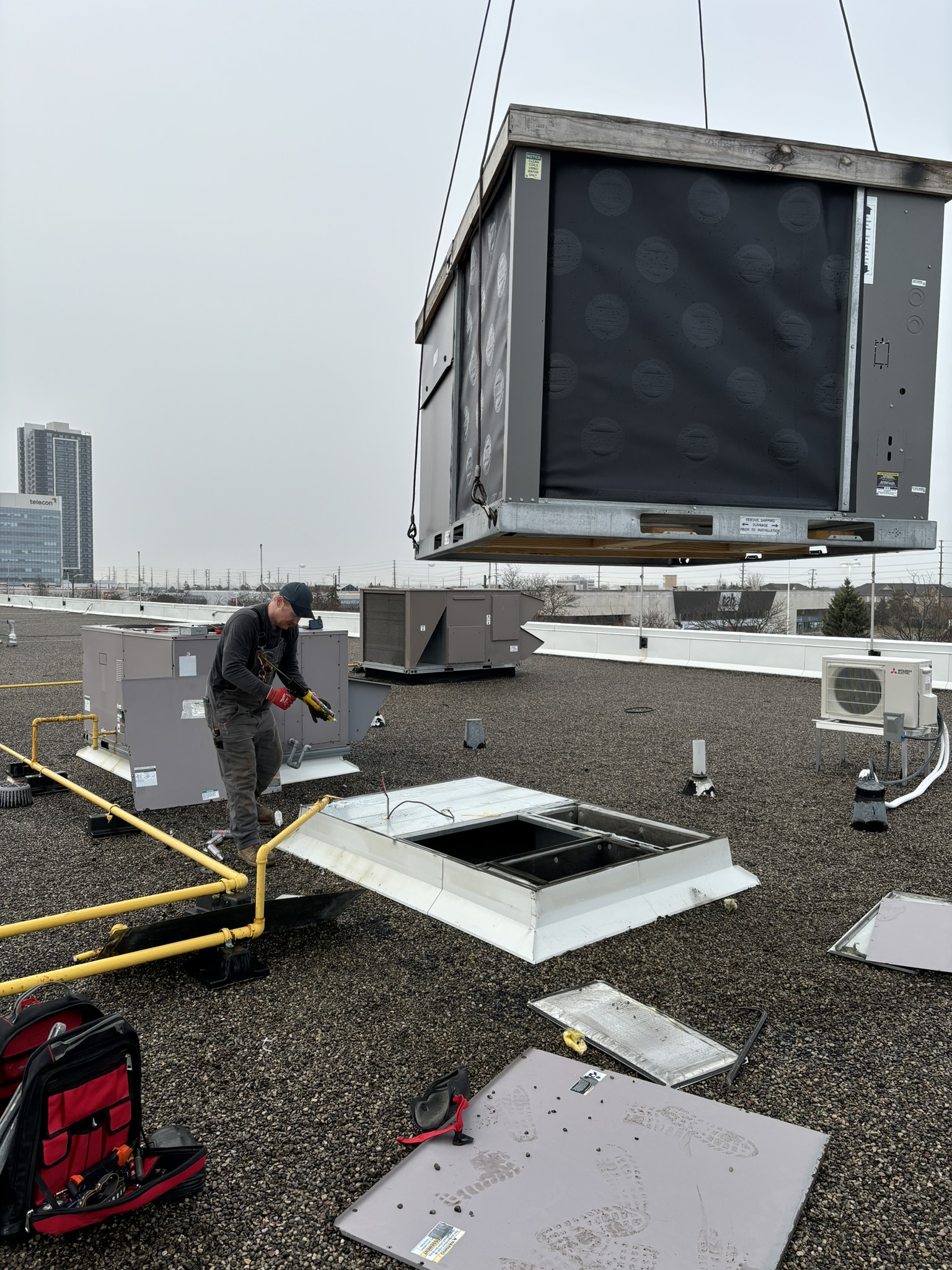
If you own or manage a commercial building in Toronto, your rooftop unit (RTU) is probably the single most important piece of equipment you never think about — until it stops working. A failed RTU doesn't just mean an uncomfortable building. For restaurants, retail spaces, and offices, it means lost revenue, unhappy customers, and in some cases, health code exposure.
Commercial rooftop HVAC in Toronto takes a beating that residential systems never see — and replacing one properly is a far more technical job than most business owners realize. Here's what actually goes into keeping an RTU running, when to repair versus replace, and what a correct installation looks like.
Why Summer Is the Hardest Season on a Commercial RTU
Rooftop units are, quite literally, sitting in the worst possible spot for a Toronto summer. A black or dark-membrane roof can hit surface temperatures well above the surrounding air temperature on a sunny July afternoon — and your RTU has to pull heat out of the building while sitting directly on top of that heat soak.
A few things compound the stress:
- Extended runtime. Long, hot stretches mean the compressor rarely gets a full rest cycle, which accelerates wear on components that are already working near their limit.
- Dirty condenser coils work harder. A coil that's even partially blocked with dust, pollen, or roofing debris forces the system to run longer to reject the same amount of heat — driving up both utility costs and mechanical stress.
- Refrigerant pressures swing wider. High ambient temperatures push head pressures up, which is exactly when a marginal component — a weak capacitor, a slightly low refrigerant charge, a tired contactor — finally gives out.
This is why most commercial RTU failures happen in July and August, not in the shoulder seasons. If your system is already showing signs of strain, summer is when it collects on the debt.
Warning Signs Your RTU Needs Attention
Most RTU failures don't happen without warning. The signs are usually there weeks or months ahead — they just get missed because nobody's checking the roof regularly. Watch for:
- Short cycling — the unit turns on and off frequently instead of running a full, steady cycle
- Uneven temperatures throughout the space, especially rooms farther from the unit running noticeably warmer
- Rising utility bills without any change in usage patterns
- Unusual noises — grinding, squealing, or a new rattling vibration
- Ice forming on the coil, visible if you can safely access the unit
- Water stains on the ceiling below the unit, which often means a clogged condensate drain
- The unit is 15+ years old — even a well-maintained RTU is statistically living on borrowed time past this point
Any one of these on its own isn't necessarily an emergency. Several together, or a system already past 15 years, is when it's worth having a proper assessment before you're dealing with a breakdown during your busiest week.
Repair or Replace? The Real Decision Framework
This is the question every business owner eventually has to answer, and it deserves more than a gut call. A few factors that actually matter:
The 50% rule. If the cost of the repair is approaching half the cost of a full replacement, and the unit is past the 12-15 year mark, replacement is almost always the better long-term investment. A major repair on an aging unit is rarely a one-time expense — it's usually the first of several.
Refrigerant type. Older units running R-22 refrigerant are an increasingly expensive problem on their own, independent of the unit's mechanical condition. R-22 has been phased out of production, and the refrigerant itself is both harder to source and significantly more costly than it was even a few years ago. A refrigerant leak on an R-22 system can turn a routine repair into a very expensive one.
Frequency of breakdowns. One repair in five years is normal wear and tear. Two or three service calls in a single season is a system telling you it's done.
Efficiency losses. Older commercial units lose efficiency well before they fail outright. A newer RTU can often pay back part of its cost difference through lower utility bills alone, especially on a unit that's been running inefficiently for years.
What Neglect Actually Costs a Business
The real cost of an RTU problem is almost never the repair bill — it's the downtime. For a restaurant, a failed RTU on a hot day can mean spoiled inventory, uncomfortable dining rooms driving customers out early, and in some cases actual health code exposure if kitchen temperatures affect food safety. For retail and office spaces, it's lost foot traffic, uncomfortable staff, and in some lease situations, tenant complaints landing on the property manager's desk.
An RTU that gets flagged early and addressed on a planned timeline is a manageable expense. An RTU that fails on a Saturday afternoon in August is a crisis — and crisis pricing, rush scheduling, and business interruption cost far more than the equipment itself ever would have.
Replacing an RTU Isn't a Drop-In Job — Here's What's Actually Involved
This is the part most people don't see, and it's where a lot of replacements go wrong. Swapping a rooftop unit looks simple from the ground — crane the old one off, set the new one down, done. In practice, there are several steps that determine whether the new unit performs the way it's supposed to for the next 15 years, or causes problems within the first year.
Measuring the existing curb. The curb is the raised frame the unit sits on, sealing the roof penetration and ductwork connection underneath. Unless you're replacing with the exact same make and model, the new unit's footprint, ductwork openings, and utility connections almost never line up perfectly with the old curb.
Curb adapters. When the new unit doesn't match the existing curb, a properly engineered curb adapter is required to bridge the two — matching the new unit's dimensions and connection points to the existing roof opening and ductwork. Skipping this step, or using an improperly sized adapter, is one of the most common sources of long-term leaks, poor airflow, and structural issues.
Sealing — the step people underestimate. Both the curb adapter and the unit itself need to be properly sealed during installation. This isn't a minor detail. I've seen commercial RTUs that were blown over in strong wind because they weren't properly secured to the curb — and when that happens, gas lines connected to the unit can shear or break, dumping gas at roof level. Most people assume a unit that size and weight simply can't move. It can, if it isn't fastened and sealed correctly. This is a genuine safety issue, not just a workmanship one.
Commissioning. Once a unit is set and connected, it has to be commissioned — refrigerant charge verified, airflow measured and balanced, gas pressure checked, and controls calibrated to the specific building. A unit that's powered on but never properly commissioned might run, but it won't run at anywhere near its rated efficiency, and it will wear out faster than it should.
Matching the unit to the ductwork. One of the most common mistakes we see is a business assuming that going bigger automatically means better performance — "I had a 3-ton unit, so let's put in a 5-ton for more cooling." It doesn't work that way. Ductwork is engineered around a specific airflow (CFM), matched to the original unit's size. Installing a larger unit onto ductwork that wasn't designed for the added airflow leads to short cycling, poor humidity control, uneven temperatures, and unnecessary equipment cost for a system that performs worse than the one it replaced. Upsizing tonnage, if it's actually needed, has to come with a real load calculation and, often, ductwork modifications — not a guess.
Choosing the Right Contractor for RTU Work
Given everything above, the contractor matters as much as the equipment. A few things worth asking any commercial HVAC contractor before they go on your roof:
- Are they licensed (TSSA registration, G2 gas certification) and carrying adequate liability insurance for commercial work?
- Do they have direct experience with curb adapters and commercial roof-mounted units specifically — not just residential split systems?
- Will they commission the unit after installation, and can they explain what that involves?
- Can they walk you through the sizing and load calculation before recommending a specific unit, rather than just matching tonnage to what you had before?
At Epsilon Mechanical, this is exactly the kind of work we specialize in across Toronto and the GTA — from diagnosing a struggling RTU to a full replacement done right the first time, with proper curb work, sealing, and commissioning on every job. Contact us for a commercial RTU assessment, or learn more about our commercial HVAC services.
Frequently Asked Questions
How long does a commercial RTU replacement take?
A straightforward single-unit replacement can often be completed in a day, though timeline depends on crane scheduling, curb adapter fabrication if needed, and any electrical or gas line work required.
Can my business stay open during an RTU replacement?
In most cases, yes — the work happens on the roof, and we coordinate scheduling to minimize disruption to your operating hours wherever possible.
How often should a commercial RTU be serviced?
Twice a year is standard — once before the cooling season and once before heating season — to catch small issues before they become breakdowns.
What's the average lifespan of a commercial RTU?
Most commercial rooftop units are designed for 15-20 years with regular maintenance, though this varies by usage, unit quality, and how consistently it's been serviced.