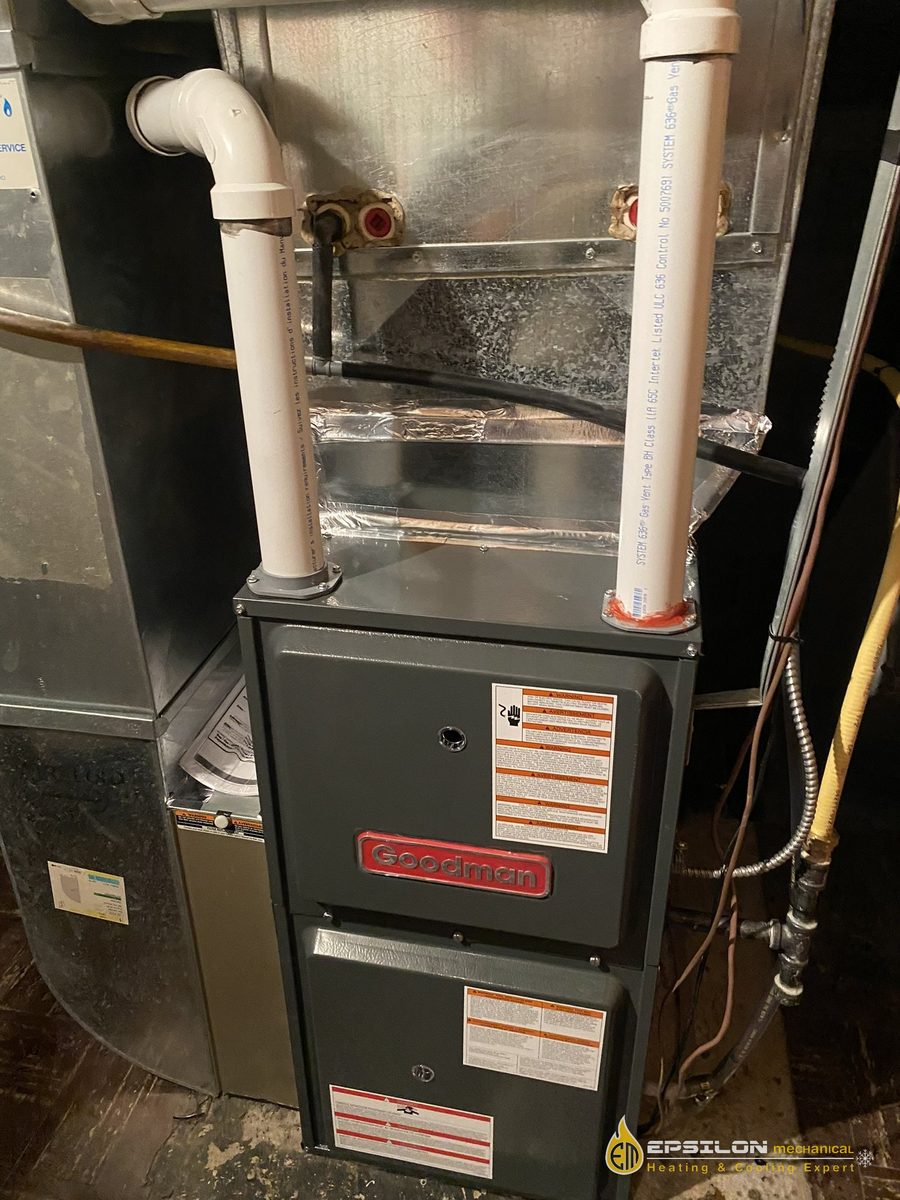
Every fall we find furnace parts that are going to fail. Not might. Will. An inducer motor pulling more amps than its rating, a blower wheel caked in dust, an igniter that's gone white and brittle. We write it up, we recommend changing it, and then it's the customer's call.
Some change it right away. Some wait. And every winter, like clockwork, the ones who waited call us on the coldest day of the year.
I'm not writing this to scold anyone. I'm writing it because the part of this that nobody explains is what happens after the part dies in January, and once you know that, the decision usually makes itself.
What Actually Happens When a Part Fails in Winter
The furnace quits on a night when it's minus fifteen. You call. So does everyone else. During a cold snap we're taking dozens of no-heat calls a day, and so is every other licensed company in the GTA. Depending on how swamped we are and what the roads look like, you may be waiting a day. Sometimes two.
Then there's the part itself. When furnaces start breaking down across the city, parts fly off the supplier shelves. A motor we could have picked up in October with no notice can take a few weeks to come back into stock in January, because the supplier is waiting on the manufacturer the same way you're waiting on us.
So the real cost of waiting isn't the part. The part costs the same in October as it does in January. The real cost is two days with no heat, a scramble for space heaters, and a possible wait for stock while the house sits at twelve degrees.
We don't recommend replacing anything unless we think the risk of leaving it isn't worth it. If a part is in rough shape but not dangerous, we'll tell you it may need attention down the road and leave it at that. If we're telling you to change it before winter, it's because we've watched that exact failure play out too many times.
What We Flag, and Why
These are the calls we make on a furnace maintenance visit, and the reasoning behind each one.
Inducer Motor
We measure the amp draw against the rating on the motor. Over the rated maximum, we recommend replacing it. Under the max but noisy or grinding, we tell you it's likely to need replacement in the future and let you decide when. Out of warranty, an inducer motor runs $650 to $850 depending on the make and model.
Igniter and Flame Sensor
If the igniter is in bad condition we replace it along with the flame sensor, as a pair. They're sold as a bundle for a reason: they fail around the same time and they're both in the way once you're in there. Expect $350 to $450 out of warranty. This is also the most common no-heat repair we do all winter, which tells you how often people skip it in the fall.
Blower Wheel
A dirty blower wheel doesn't need a new motor. It needs a cleaning: we pull the blower assembly, vacuum it, clean it, and wash it. Skip that for long enough and the motor runs hot and unbalanced, and then you're into a motor. A DC blower motor is $750 to $950 out of warranty. An ECM motor is $1,300 to $1,600.
Heat Exchanger
This one's different. If combustion testing shows a problem with the heat exchanger, we're not talking about preventive replacement. We're talking about shutting the furnace down and having a conversation about a new unit, because a heat exchanger replacement is $2,000 to $3,000 and involves pulling the entire furnace out. I'll cover the testing in a separate post.
What This Looks Like Across 170 Furnaces
This fall we're working through roughly 170 mid-efficiency, chimney-vented furnaces in a single townhouse complex in the GTA. Same model, same age, same install. When you see that many identical units back to back, the patterns stop being opinions. The same motors are tired. The same igniters are white. And the units that were serviced regularly are in noticeably better shape than the ones that weren't, even though they've all lived through the same winters.
That's the whole argument for annual maintenance in one job site. Not because a tune-up fixes everything, but because it's the only time anyone looks before the furnace is under full load.
It's Still Your Call
Everyone's finances are different, and I'd rather you know the trade-off than have me push you. If the furnace is old and the part is expensive, there's a real question about whether to put that money into a repair or into a new unit, and we'll have that conversation with you honestly. If it's a small part on a furnace with years left in it, change it in the fall and sleep fine in January.
Either way, we'll give you our recommendation and the reasoning. Then the choice is yours. If you want us to look at your furnace before the cold sets in, book a tune-up and we'll tell you exactly what we find.
Frequently Asked Questions
Why do HVAC technicians recommend replacing furnace parts before they fail?
Because the part costs the same whenever you replace it, but a failure in January comes with a one- to two-day wait for a technician during a cold snap, and sometimes a wait of weeks for the part itself, since suppliers run short when furnaces break down across the city at once.
What furnace parts most often fail in winter in Toronto?
Igniters and flame sensors are the most common no-heat repair, followed by inducer motors and blower motors. Each of these usually shows signs of wear at a fall tune-up well before it fails under winter load.
How much do common furnace repairs cost in Toronto?
Out of warranty, an igniter and flame sensor pair runs $350 to $450, an inducer motor $650 to $850, a DC blower motor $750 to $950, and an ECM blower motor $1,300 to $1,600. Exact pricing depends on the make and model of the furnace.
Should I replace a part on an old furnace or replace the whole furnace?
For a small repair like an igniter and flame sensor, it's usually worth getting through the season even on an older furnace. For an expensive part on a furnace around 15 years old with other signs of wear, that money is often better put toward a new unit with a full warranty. A good technician will walk you through both options.